
When Smoke Speaks: Remembering the Ancient Language of Incense

Before smoke was something to clear a room, it was something to carry meaning.
Across ancient cultures, incense was not a generic act of purification. It was a language — precise, intentional, and widely understood by those who knew how to listen. Different resins, woods, and herbs were chosen not for aroma alone, but for what they signaled.
Smoke was never just smoke. It was a message in motion.
Incense as Communication, Not Cleansing
Modern frameworks often reduce incense to function: to cleanse, to remove, to reset. In older traditions, incense served a different role. It was a bridge, not a broom.
In ancient Egypt, complex incense blends like Kyphi were prepared with care and used at specific times of day. Each ingredient corresponded to planetary rhythms, bodily states, and spiritual intentions. Burning incense was not spontaneous — it was timed.
In the Levant, frankincense and myrrh blends marked prayer, mourning, hospitality, and covenant. The smoke did not erase presence; it announced it.
Incense was how the invisible was addressed respectfully.
Smoke as Breath Made Visible
One reason incense carried such authority is that it mirrored breath.
Smoke rises, curls, disperses. It moves like respiration. In many traditions, this made it an intermediary between the human body and the unseen world. What breath did internally, smoke did externally.
To tend incense was to tend atmosphere.
This is why it was rarely rushed. Incense was watched. Its movement mattered. The way it lingered, thinned, or drifted was observed — not interpreted theatrically, but noted.
Attention was part of the practice.
Coded Materials, Not Arbitrary Scents
True incense craft relied on discernment, not abundance.
Resins were chosen for stability. Woods for grounding. Herbs for specific qualities of tone or direction. Not everything was burned together. Certain materials were never combined.
This selectivity was ethical as much as practical. Too much smoke overwhelmed space. Too many ingredients muddled meaning. The goal was clarity, not intensity.
Incense was effective because it was restrained.
Why Smoke Was Trusted
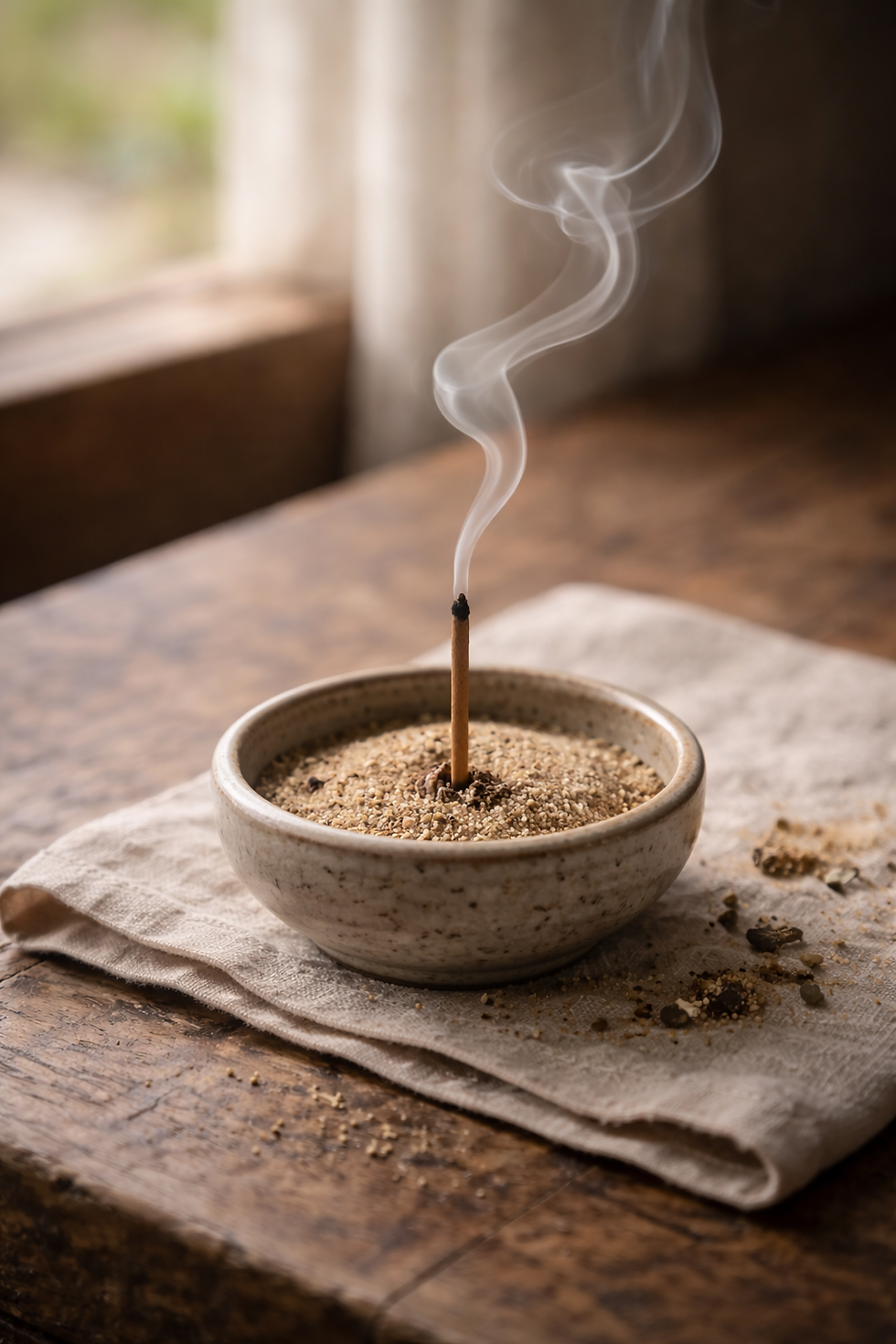
Unlike more permanent offerings, smoke disappears.
This impermanence made it safe. It did not linger indefinitely. It did not anchor energy to place or object. It arrived, communicated, and left.
Because of this, incense was often used in shared or transitional spaces — temples, thresholds, gatherings — where permanence was neither possible nor desired.
Smoke allowed presence without possession.
April and the Return of Breath
April brings expansion.
Windows open. Air shifts. What was held close begins to circulate again. Incense belongs here not as purification, but as attunement — a way of noticing how atmosphere changes when breath moves freely.
This is not a call to burn more. It is an invitation to remember that air itself carries meaning.
Closing Reflection
Smoke was never meant to overpower.
It speaks softly, moves briefly, and leaves no trace except awareness. When tended with care, it teaches us how to communicate without forcing — how to be present without remaining.
That, too, is a language worth remembering.



Comments